
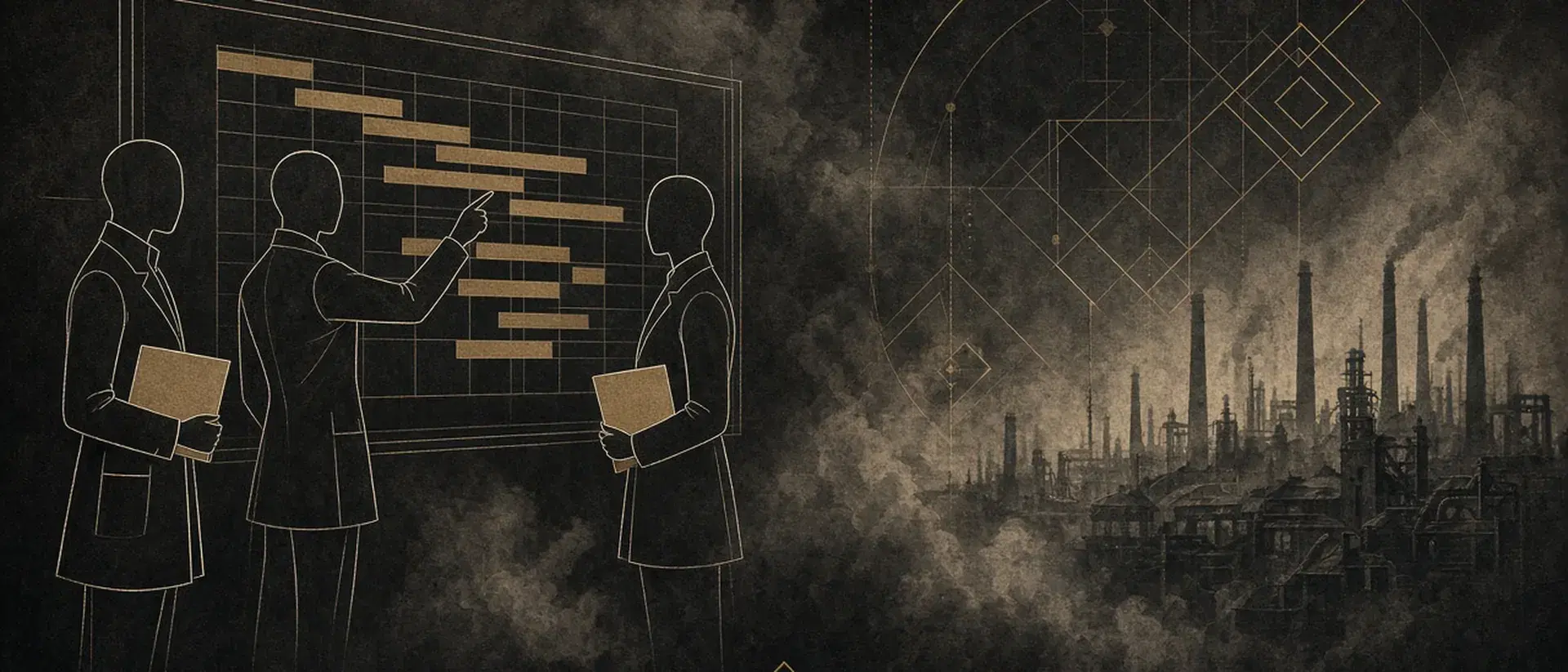
SKV-PAS-1010
Schedule Compression: Time-Cost Tradeoffs and Recovery Strategies
Currently available for free preview
00:53:23·intermediate·4 modules·10 lessons
Currently available for free preview
About this course
Projects rarely lose time because the schedule itself is wrong. More often, the challenge comes when a project must finish earlier than planned—or recover time already lost. At that point, simply asking teams to “work faster” is not a schedule strategy. Project professionals need to understand where time can actually be recovered, what it will cost, what risks it introduces, and when further compression stops being worthwhile.
Schedule Compression: Crashing, Fast-Tracking & Recovery equips planning engineers, project controls professionals, and project managers with a practical framework for making those decisions using CPM networks and time-cost tradeoffs.
The course begins by establishing what schedule compression really means and distinguishes acceleration from recovery. You will then examine the two primary compression techniques: crashing, which reduces activity duration through additional resources or cost, and overlapping (fast-tracking), which changes the network logic by performing normally sequential work in parallel.
From there, the course moves into the analytical core of schedule compression. You will build time-cost tradeoff tables using Normal Time, Normal Cost, crash duration, crash cost, and crash slope, and learn how to identify the least-cost opportunities for reducing project duration. Through progressively more complex CPM examples, you will practice selecting activities to crash on single critical paths and evaluating combinations when multiple critical paths exist.
The course then shifts from calculation to real project decision-making. You will explore practical acceleration tactics—including extended working hours, additional crews or contractors, and strategic removal of non-critical work—and examine how productivity loss, coordination demands, rework, and resource constraints can undermine an aggressive recovery plan.
The final lessons bring these concepts together through recovery and acceleration scenarios. You will learn how to decide when to crash, overlap, combine methods, or stop compressing, and how to recommend a defensible course of action when cost, resources, network logic, or preferential relationships limit further schedule reduction.
By the end of the course, you will be able to move beyond simply identifying that a project is behind schedule and make a structured recommendation about how much time can realistically be recovered, which activities should be targeted, what the incremental cost and risk may be, and what alternatives remain when compression reaches its practical limits.
What you will cover
01Module 1 · Why compress
- Acceleration vs recovery: same scope, less time
- Two primary techniques at a glance
02Module 2 · Crashing and overlapping in depth
- Crashing: resources, cost, and crash subtypes
- Overlapping (fast-tracking): parallelizing sequential work
03Module 3 · Time-cost tradeoff and CPM crash selection
- Normal Time, Normal Cost, and crash slope
- Single critical path: least-cost one-unit crash
- Multi-path networks: combinations and least additional cost
04Module 4 · Acceleration tactics, recovery, and decisions
- Acceleration tactics and productivity risk
- Recovery schedules: combining methods without over-promising
- Decision guide: crash, overlap, or alternative
More in Skillvault

SKV-CMA-1040
Subcontracting and Back-to-Back Arrangements
Free preview
A short, practice led course on reading, pricing, and managing the risks hidden inside subcontract and back to back arrangements. A subcontract can look straightforward on the page…
00:26:52·intermediate

SKV-CMA-1030
Exclusion and Limitation of Liability
Free preview
Equip construction professionals to read a limitation suite clause by clause, test it against the reasonableness control, and price real exposure — caps, carve outs, net contributi…
00:24:02·intermediate
SKV-CMA-1020
Consultant and Professional Liability
Consultant and Professional Liability Learn how professional liability actually plays out — not through theory, but through one continuous case study you follow start to finish. A…
00:36:23·intermediate
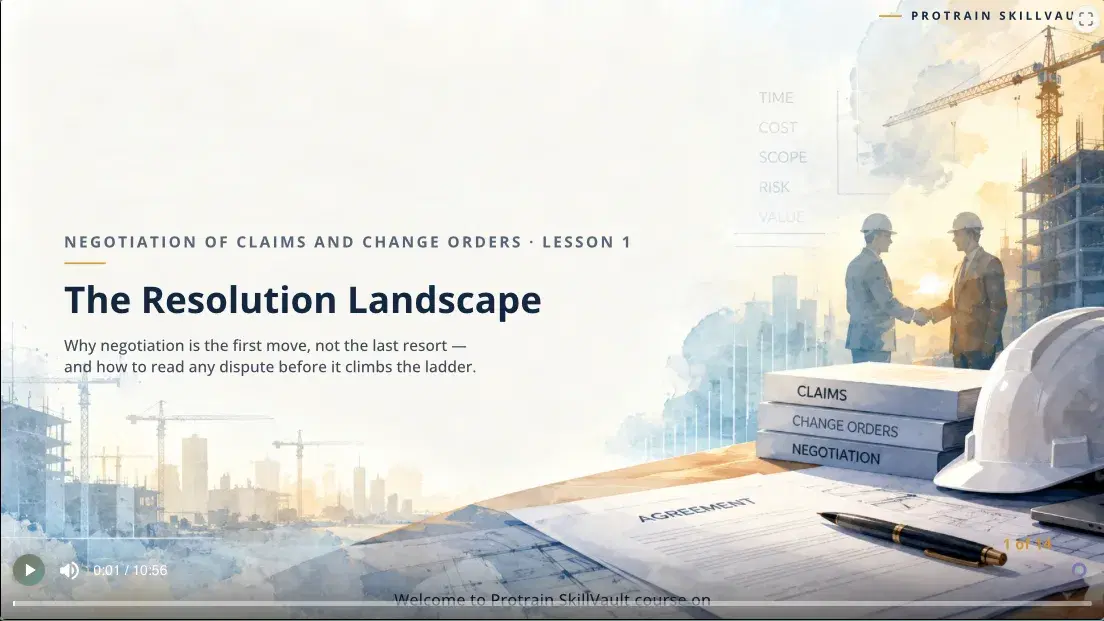
SKV-CMA-1010
Negotiation of Construction Claims and Change Orders
Free preview
Negotiation of Construction Claims and Change Orders is a three lesson, practice first course that walks you through the exact moves professionals use to settle construction disput…
00:51:41·intermediate